This article was originally featured in the Summer 2026 edition of Hope Quarterly.
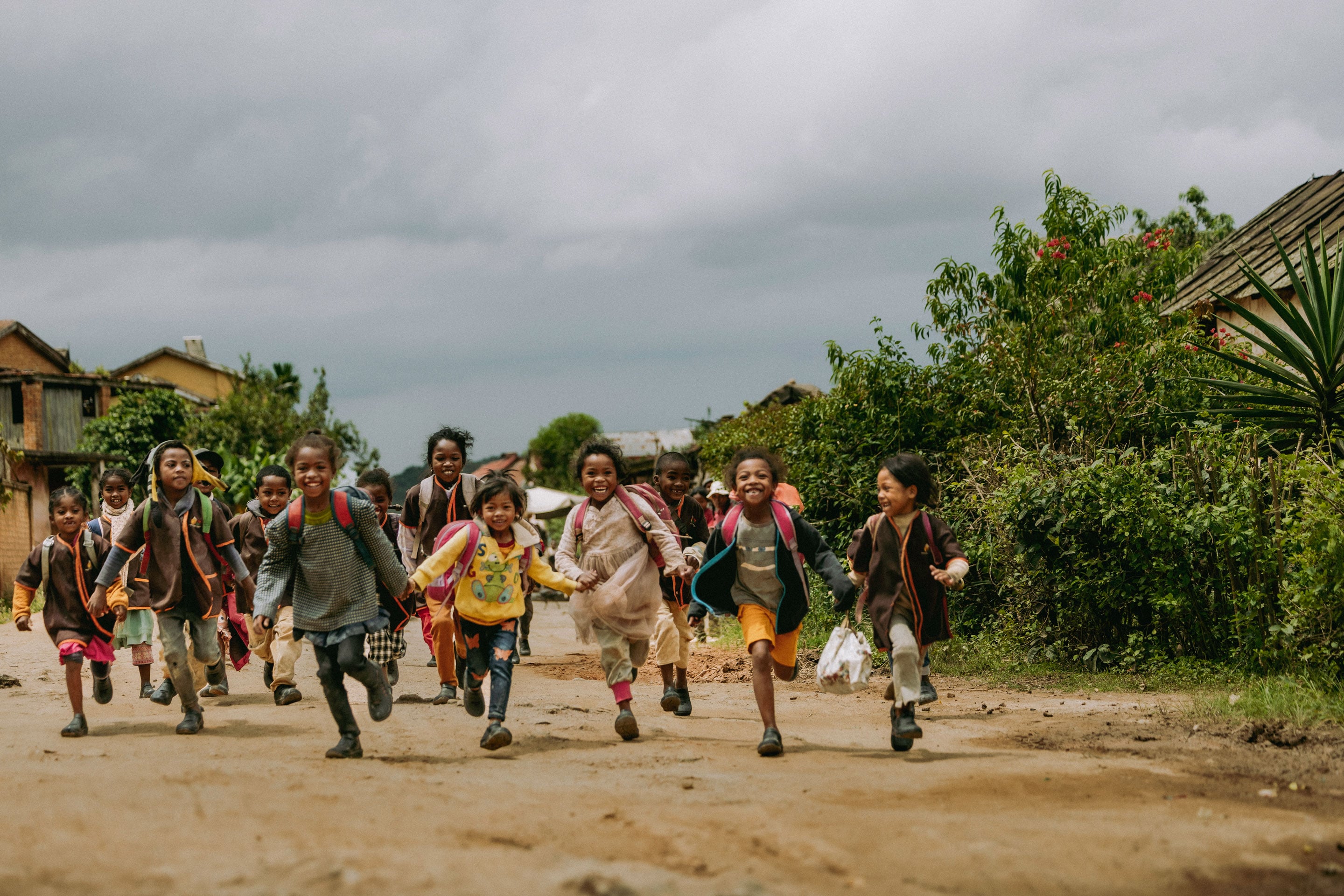
In an overcrowded, yet strangely quiet, classroom in a remote village a world away from most every modern convenience, hope echoes like pattering rain on a tin roof.
Tap.
Tick.
Tick.
Tap.
Here, more than 50 first-graders cradle a hardboiled egg in one hand and a spoon in the other. One by one, in a gentle chorus, they crack the coveted appetizer that’s packed with 6 grams of protein. After the eggs are consumed, the children turn their spoons toward overflowing bowls of fortified rice, potatoes, and carrots.
The same gentle ritual takes place in 71 schools throughout Madagascar. Most families here work the land, which gives just enough to survive, but hardly enough to get ahead.
In fact, 70 percent of families in Madagascar live in extreme poverty, and 350,000 children suffer from acute malnourishment — meaning their bodies are dangerously deprived of nutrients in the most critical stages of growth. If untreated, stunting and even death are possible.
This cruel reality forces parents to ask a difficult question with each rising sun: Send the children to school or to work?
If children go to school, the family’s earning power is drastically diminished. If they work, reading, arithmetic, writing — childhoods, really — go by the wayside. Convoy of Hope is determined to give children their childhoods back.
Today, 10,600 children across the island are fed each school day, and thousands of families are empowered and equipped to transform their communities from the fields up. It’s not easy.
The infrastructure is so poor here that even local tourist companies — who try to coax international travelers to come see the lemurs and baobab trees — issue warnings such as: Avoid Madagascar altogether if you like comfort, predictability, and good
roads.
70%
of families live in extreme poverty
350,000
children suffer from acute malnourishment
Alice Rahelimalala, national director of Convoy of Hope in Madagascar, acknowledges the challenges but chooses to be opportunity-focused.
“To help as many people as we do requires us to work in the most remote, and often, most overlooked communities where the poorest of the poor live,” she says.
On this day, she leads a team of volunteers from the U.S. National Football League. A few minutes outside of Antananarivo, the capital, paved roads abruptly turn into dirt tracks filled with a gauntlet of potholes, ruts, and other maladies that could just as easily flatten a tire as they could flip a truck or snap its axle.
Hours later, the team arrives at a Convoy community garden deep in the mountains. Men and women — all parents of children receiving food through Convoy of Hope — turn rich soil, hoe weeds, tend to plants, and dream big for their families’ futures.
“These gardens feed our children,” says Falimanana, 42, a father of three. “We now have money for other necessities, but more importantly our children see that God loves them. They’re growing independent and are empowered to chase their futures.”
Rahelimalala quickly notes that in schools where Convoy of Hope feeds children, the enrollment increases and absenteeism plummets. Children hardly miss a day because that’d mean missing the egg and meal. Families who have only ever known being slighted and overlooked suddenly have a stake in their future.
“Our asset-based community development model builds on the present strengths of a community until everyone is empowered to live self-sustaining lives,” she says. “The goal is to phase over — exit — so that we can help more communities.”
Asset-based community development isn’t for the faint of heart. It demands buy in, hard work, delegation, sharing, self-leading, and sacrifice. In other words, no handouts. The Malagasy people wouldn’t have it any other way.
Take agriculture, for example. Convoy provides seeds, manure, rent, and training on best practices. In return, communities must elect leaders, provide land and labor, abide by strict food safety and storage protocols, and commit to work toward a common goal — everyone who participates, benefits.
Even girls who join Convoy’s Girls’ Empowerment program must pay two cents annually. Doing so creates immediate ownership. “I earned this. I chose this!” is a common refrain.
Ownership has a price.
At a drying house in a tiny village, deep in a valley
surrounded by rice paddies, a dozen women meticulously dehydrate food (fruit, vegetables, and even beef). Here, Convoy’s Women’s Empowerment program comes complete with lab coats, hair nets, and gloves. This high-yielding enterprise provides not only a livable income for its participants, it provides margin.
Thanks to you,
Convoy of Hope
is bringing help
and hope to the
Malagasy people.
“This is about networking and learning leadership skills,” says Sarobidy, an ambitious 23-year-old single mom. “We not only get to help ourselves and the children in our community, we get to support families throughout the country.”
The food dried here will be transported by Rahelimalala’s team to the Grand Sud (or deep south) where the climate has wreaked havoc.
Chronic drought, poor soil, scarce water, limited infrastructure, and brutal roads have turned a seasonal hunger problem into years
of food insecurity for countless families. It’s to the point, according to some reports, where families have resorted to eating cactus leaves, locusts, and wild roots.
Open the aperture wider — to all of Africa — and find nearly as many people living malnourished or hungry as there are people residing in the United States (well over 300 million souls).
Unacceptable.
When a young Malagasy mother is asked what she wants the world to know about her people, she gets serious. “We love God, and we work hard,” she says, “but if all we do is pray — and don’t work hard — we don’t eat!”


